Pearson Edexcel · GCSE · Psychology
Course version: 1PS0 · Version from Sept 2017
Understand research methods, including the features, strengths and…
Full specification wording
Designing psychological research: Understand research methods, including the features, strengths and weaknesses of the following, and the types of research for which they are suitable:
Psychologists use various research methods, each with distinct features, strengths, and weaknesses.
Checked against the Pearson Edexcel 1PS0 specification (opens in a new tab) on .
- Point 9 of 17
- 4 key terms
Study notes
From the checked teaching notes for this specification point.
The idea
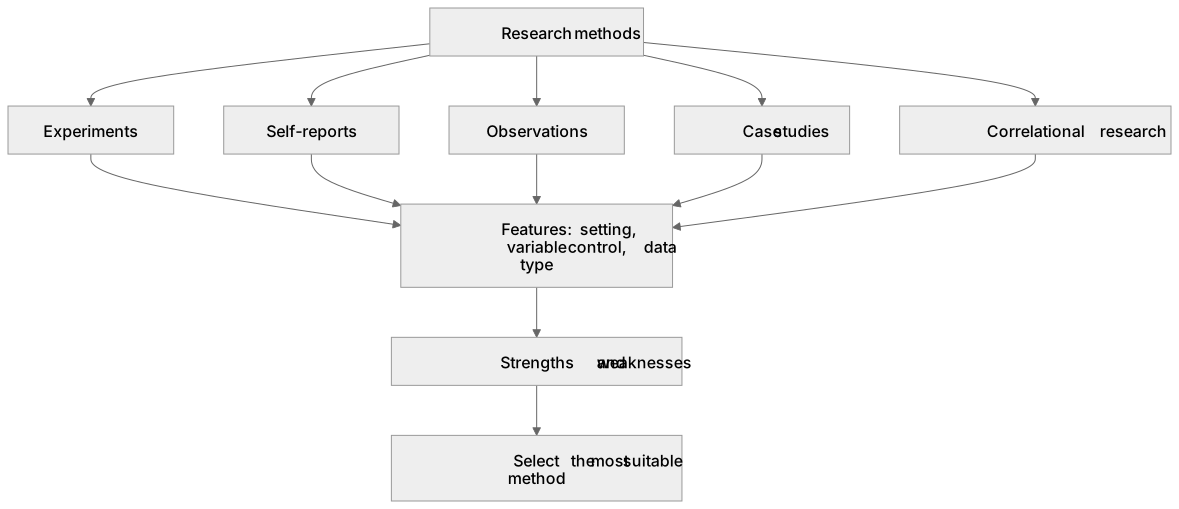
Psychologists use various research methods, each with distinct features, strengths, and weaknesses. Key methods include experiments, self-reports, observations, case studies, and correlational research. Features include the setting, variable control, and data type. Strengths often involve high internal or ecological validity, while weaknesses include demand characteristics, researcher bias, or ethical issues. Understanding these allows researchers to select the most suitable method.
For example: A laboratory experiment is suitable for establishing cause and effect due to high control, whereas correlational research is ideal for identifying relationships between two co-variables without manipulating them.
What earns the marks
- Identify the features of specific research methods, such as the high control in laboratory experiments or the measurement of co-variables in correlational research.
- Explain one strength of using a particular research method, such as the high ecological validity of naturalistic observations.
- Explain one weakness of a chosen research method, such as the potential for social desirability bias in questionnaires or the inability of correlations to establish cause and effect.
- Justify why a specific research method, like a case study, is suitable for investigating rare or unique psychological phenomena.
Common mistakes and how to put them right
Stating that laboratory experiments are always the best method.
Put it right: Recognise that while they offer high control, they often lack ecological validity compared to field experiments.
Assuming correlational research establishes causation.
Put it right: Correlations only show a relationship between co-variables; they cannot prove that one variable causes changes in another.
Providing generic strengths or weaknesses without linking them to the scenario.
Put it right: Contextualise the evaluation point, explaining how it specifically affects the study described.
Exam tips
- When asked to evaluate a research method, ensure you provide a balanced argument by discussing both strengths and weaknesses.
- Use specific terminology such as 'ecological validity', 'demand characteristics', 'co-variables', and 'extraneous variables' when discussing strengths and weaknesses.
- Always read the scenario carefully to determine which research method is being used before attempting to evaluate its suitability.
Try the lesson
The start of the Designing psychological research: Understand research methods, including the features, strengths and weaknesses of the following, and the types of research for which they are suitable: lesson, made from checked teaching notes for this specification point.
Have a go first
When designing psychological research, why is it important for a researcher to evaluate the strengths and weaknesses of different research methods?
Listen
Psychologists use various research methods, each with distinct features, strengths, and weaknesses. Key methods include experiments, self-reports, observations, case studies, and correlational research. Features include the setting, variable control, and data type. Strengths often involve high internal or ecological validity, while weaknesses include demand characteristics, researcher bias, or ethical issues. Understanding these allows researchers to select the most suitable method. For example, a laboratory experiment is suitable for establishing cause and effect due to high control, whereas correlational research is ideal for identifying relationships between two co-variables without manipulating them. A strong answer earns marks for these points. Identify the features of specific research methods, such as the high control in laboratory experiments or the measurement of co-variables in correlational research. Explain one strength of using a particular research method, such as the high ecological validity of naturalistic observations. Explain one weakness of a chosen research method, such as the potential for social desirability bias in questionnaires or the inability of correlations to establish cause and effect. Justify why a specific research method, like a case study, is suitable for investigating rare or unique psychological phenomena. A common slip: Stating that laboratory experiments are always the best method. Instead, Recognise that while they offer high control, they often lack ecological validity compared to field experiments. Exam tip: When asked to evaluate a research method, ensure you provide a balanced argument by discussing both strengths and weaknesses.
See it
Key words
Say what each word means before you turn the card.
Research methods
Try answering aloud or in your head before turning the card.
Ecological validity
Try answering aloud or in your head before turning the card.
Co-variables
Try answering aloud or in your head before turning the card.
Demand characteristics
Try answering aloud or in your head before turning the card.
See every definition
- Research methods
- Experiments, self-reports, observations, case studies and correlational research, each with distinct features, strengths and weaknesses.
- Ecological validity
- A strength of naturalistic observations, and something laboratory experiments often lack compared to field experiments.
- Co-variables
- Two variables measured in correlational research to identify a relationship between them without manipulating them.
- Demand characteristics
- A weakness of some research methods, alongside researcher bias and ethical issues.
Label the diagram
Some boxes have lost their names. Pick the right name for each number.
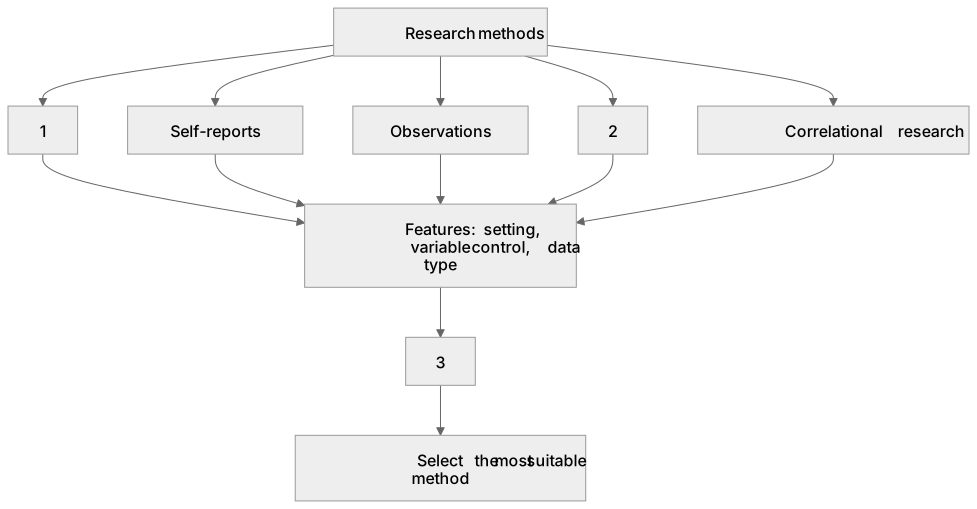
1Box 1
2Box 2
3Box 3
There is more to this lesson
The full lesson goes on to check your understanding and help you earn the marks. Create a free account to carry on, with your progress saved.
A week of Premium from your first lesson · Then the free plan continues · No card, no charge
Test your understanding of Designing psychological research: Understand research methods, including the features, strengths and weaknesses of the following, and the types of research for which they are suitable:
Active recall beats re-reading. Take an instant quiz now to test what you’ve learned and lock it into long-term memory.
A week of Premium from your first lesson · Then the free plan continues · No card, no charge